
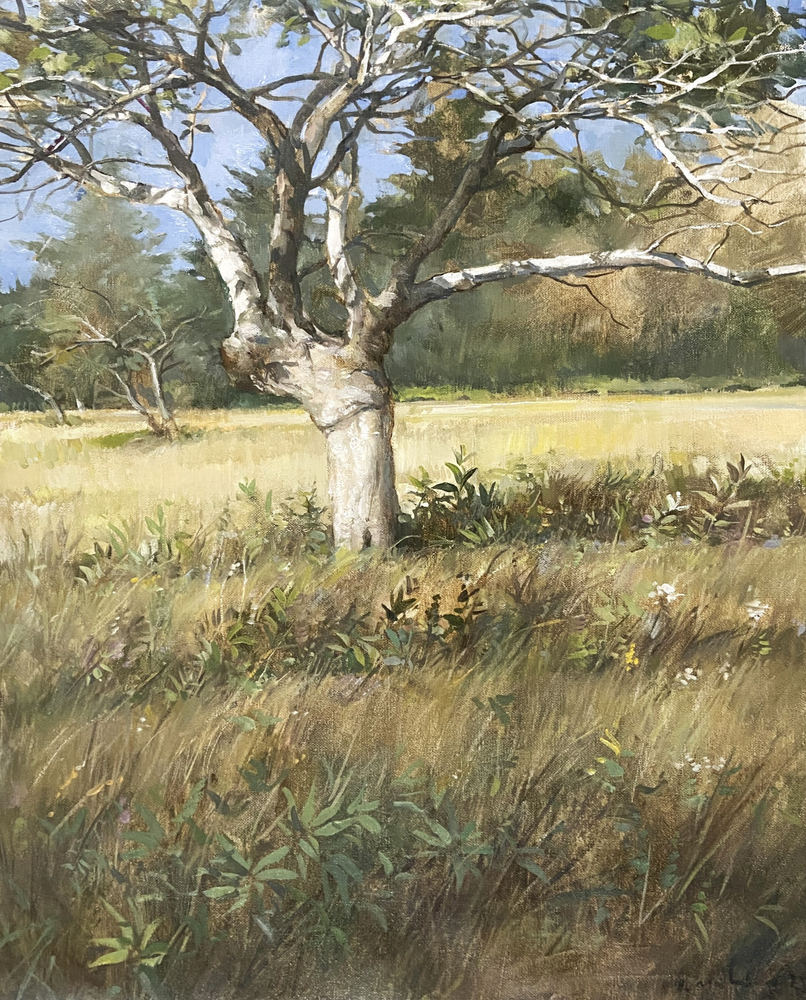
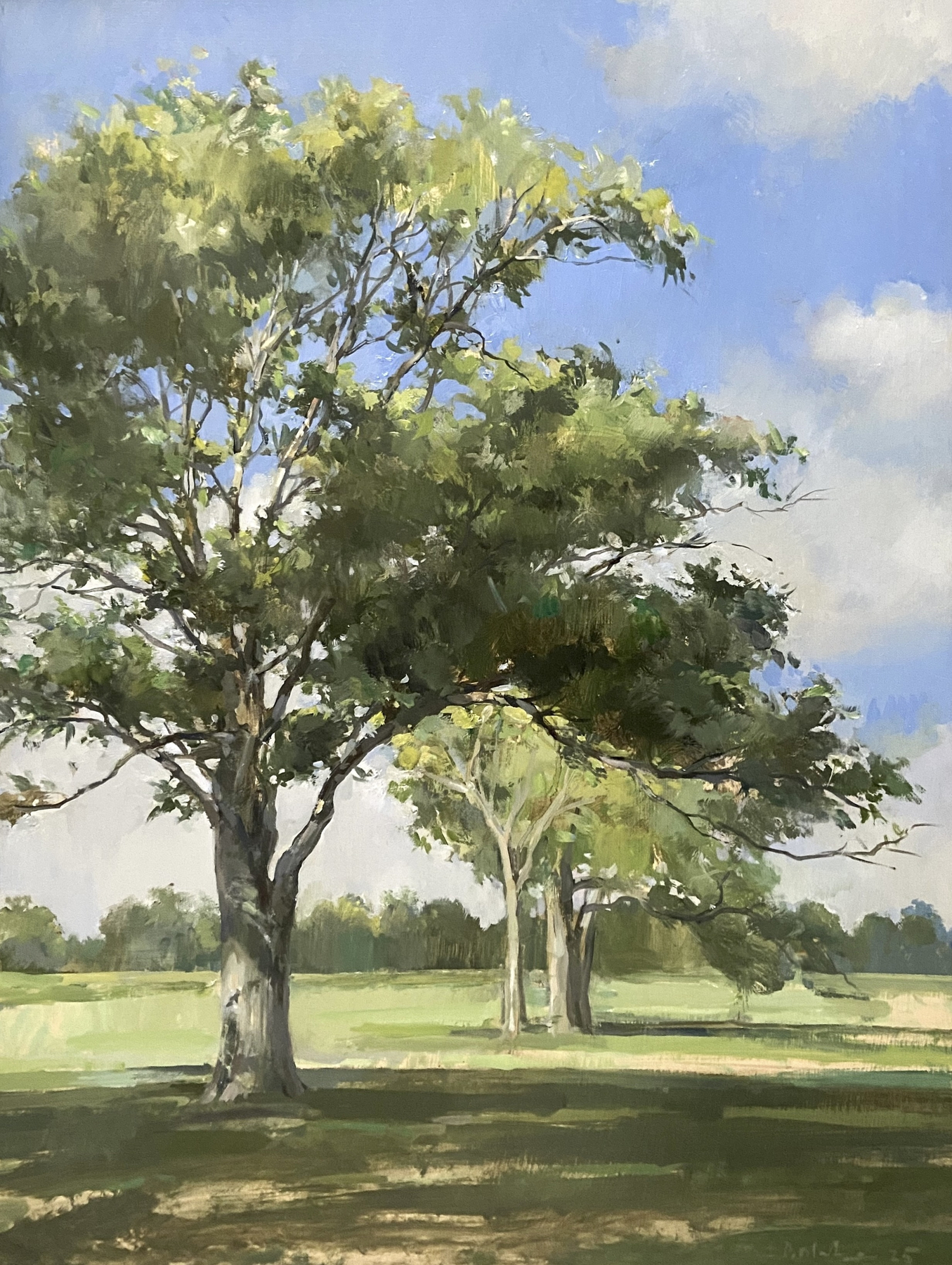
Orchard Tree, Oil on canvas, 10" x 16"
Elizabeth Johnson: Your previous show at Gross McCleaf Gallery was titled Resilience. The title of your current show is The Meadow, Encounter, which signals deeper engagement with your special place. Are you still working mostly at the Maine farm you rent for the summer? Have there been dramatic physical changes to the property?
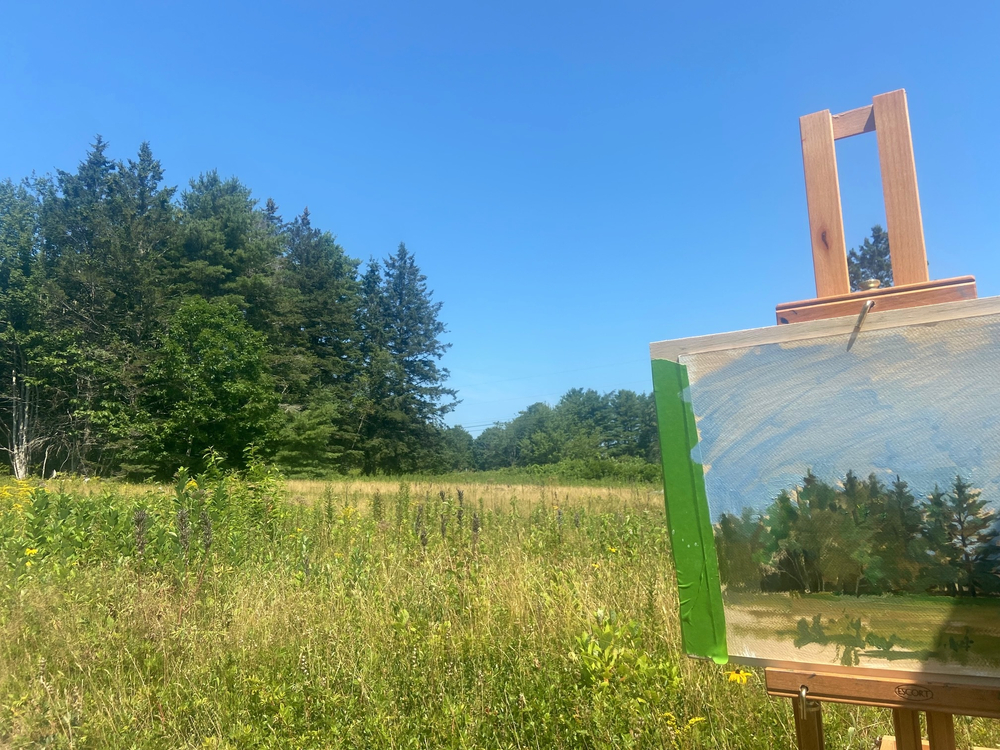
Douglas Martenson: Most of them do come from the meadow at the farm. It's kind of funny that time passes and land evolves, and in my case the work's emanating from this meadow. I am using Meadow versus Field to better express my aspirations for these paintings. At this point, I feel I can represent complex images that interest me and often baffle me.
EJ: In our previous interview for Resilience, I asked, "Do the paintings grapple with feelings about what we value or ignore, and what is vulnerable or neglected, and you answered, "To me, a field is always shifting, evolving, changing. It is a complex ecosystem. I try to make sense of it, search for patterns to bring out objects, frame them with space that surrounds them. It becomes a meditative state that is romantic at its core. I am searching for the relationship between humans and their always-changing environment." Have you felt your identity as an artist shift in relation to nature since Resilience?
DM: Yes. And as a person too. We get so much of our identity from how others perceive us, engage with us. This parallels the way I perceive the meadow: it exists already but when I represent it, it then becomes known through me as an artist.
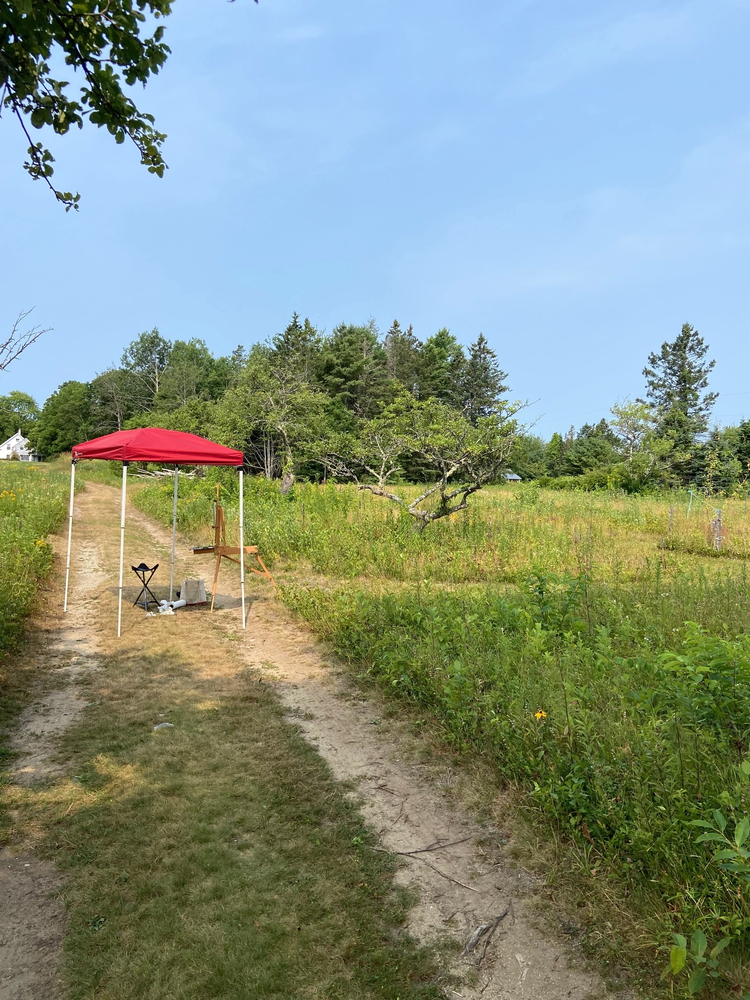
Douglas Martenson painting in a Maine field
DM: I am always seeing something more, going deeper, finding ways to relate this uncommon subject to a broader audience. I love the idea of a chance encounter, inviting the viewer into a moment that is already changing. Nothing stays the same. Currently, everything in the world is in transition, each day brings new events to deal with. These paintings are speaking of the complexity of what it takes to render light and make marks necessary to create lifelike images.
EJ: In an email you say: "For this show, I'm starting with depictions of the entire Field/Meadow and then progressing inside to show what's happening underneath the surface." What do you mean by "underneath the surface?" Does changing light on different milkweed plants, as in Morning Light and Milkweed Afternoon, capture time and thus keep you metaphorically under the surface of the whole? Does the meadow feel less of a jumble this year?
DM: There is truly common ground. Depending on where I am in the meadow, there are wetlands that have more shade, there is the old orchard where the plants are less developed, and there is the area closer to the sea that is grassier and more windswept.
In painting, just as in life, there is a lot “under the surface." We spend our lives developing the skills necessary to paint, and when you work with imagery, an image takes hold, and all it takes to get there drifts away. The lively brushwork, color representing light, composition all gets overlooked, and the image takes center stage. As artists we appreciate paintings that still show process; it's like we are let in on the story. When you remove these breadcrumbs, the viewer is left on their own to navigate. Lately, I show less of the process because it opens the work up to more interpretation, more engagement, and, I hope, a more rewarding experience. I want the viewer to feel they know something previously unnoticed.
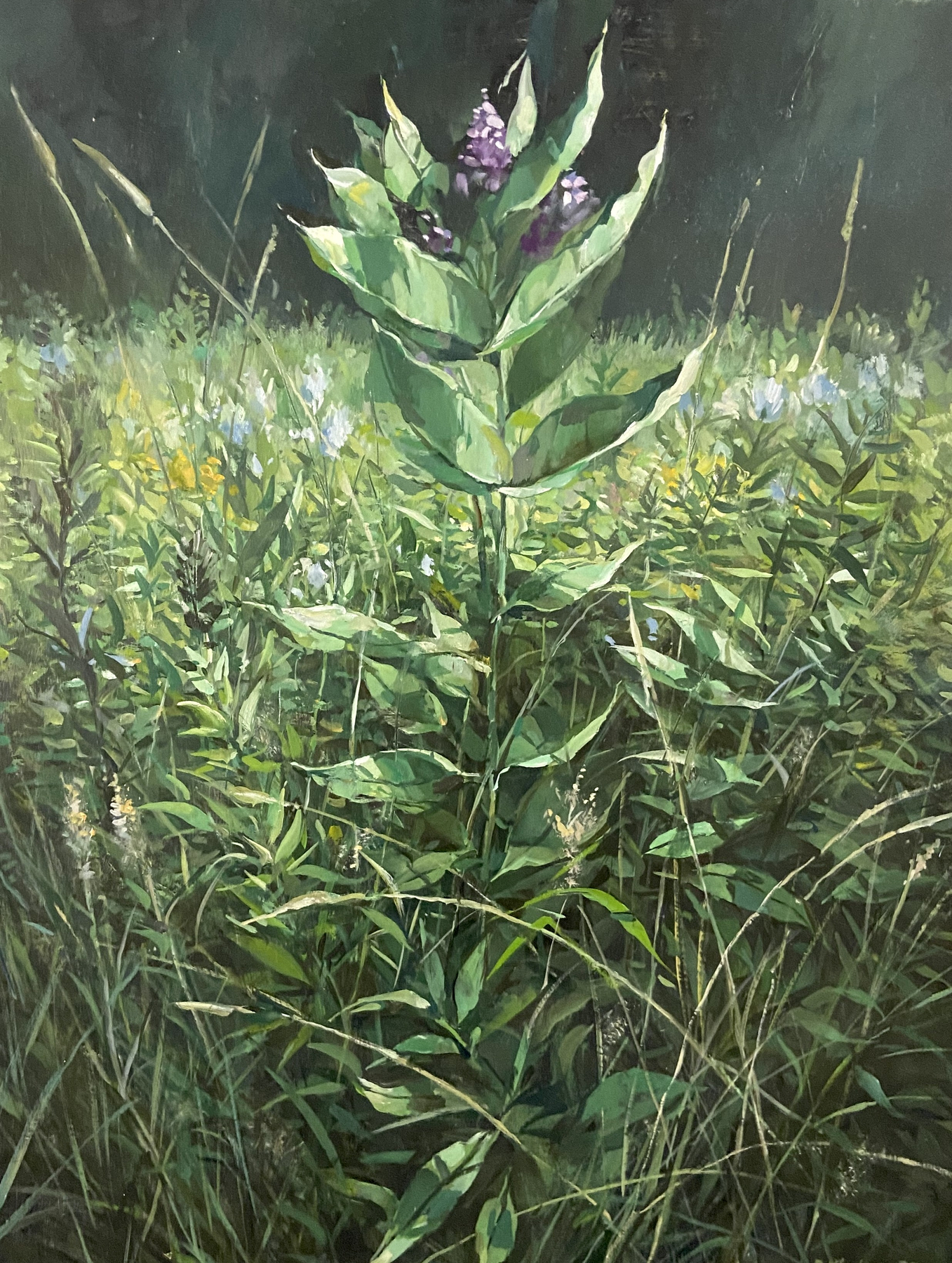
Milkweed Afternoon, Oil on wood, 24" x 18"
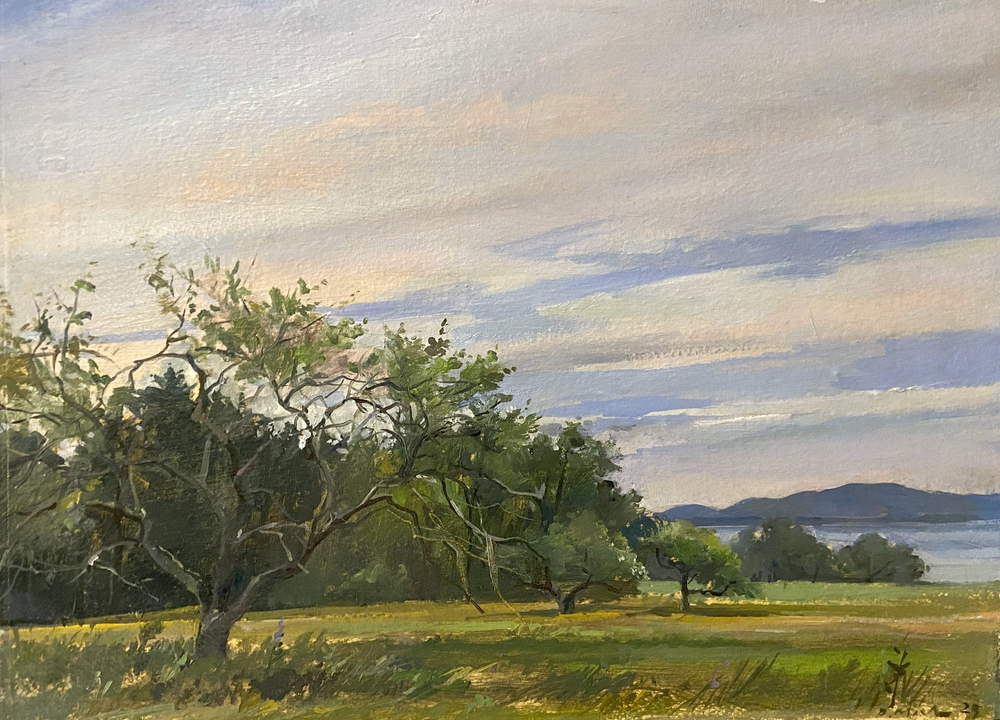
Summer Study, Oil on wood, 11" x 15"
EJ: The last time we chatted about Resilience you said, "I don't show you the field I reference it...Tension is created by what is going on or beside the scene. My paintings take the spectator on a visual journey to the edge of the field. The work is asking where nature and civilization begins and ends." What made you decide to dive in and engage the whole meadow for this show?
DM: I am still working with the idea of where nature and civilization begins and ends––fires and changing climate are literal manifestations of this. What we are trying to obtain is meaning between them and joy in the commonplace, the ordinary. Movie director (and PAFA grad) David Lynch died this past year. What I always found interesting about his work is that he showed or at least alluded to what's below the surface. When someone is walking on the grass, what is happening in this ecosystem? What if there was a camera there? If we walk on the ground, we affect it––that's the encounter. We affect that ground.
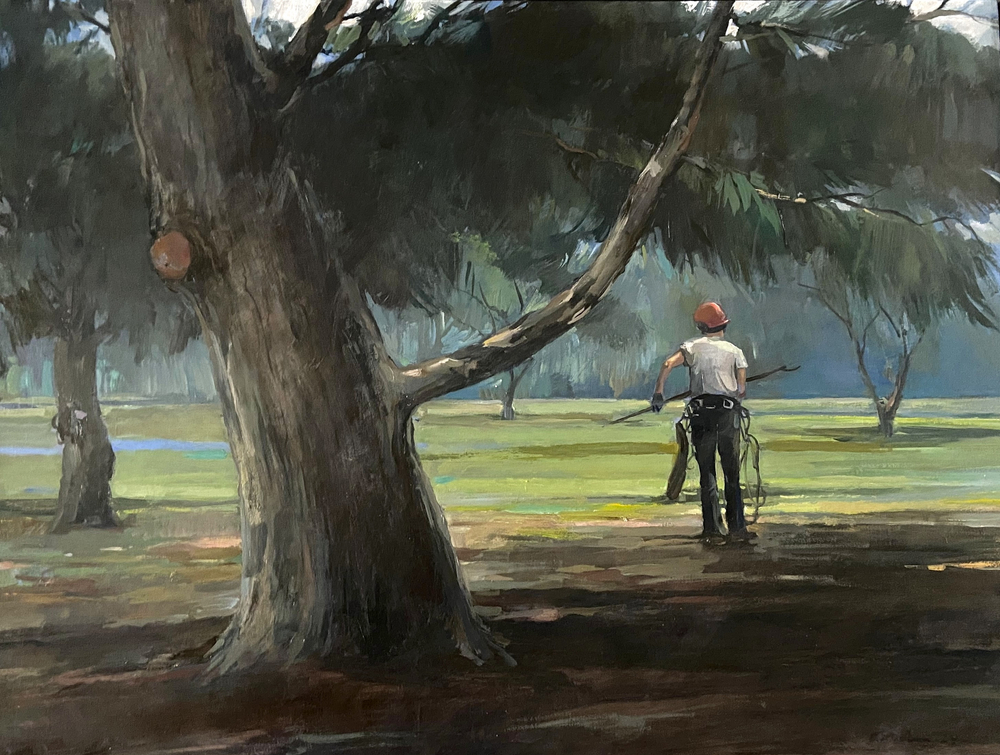
Hunt, Oil on canvas, 24" x 32"
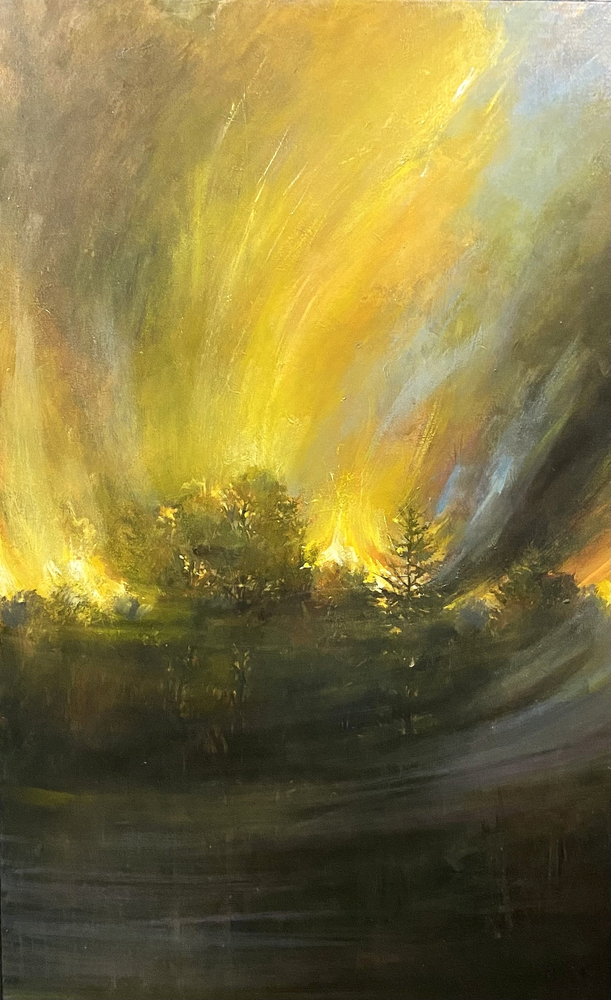
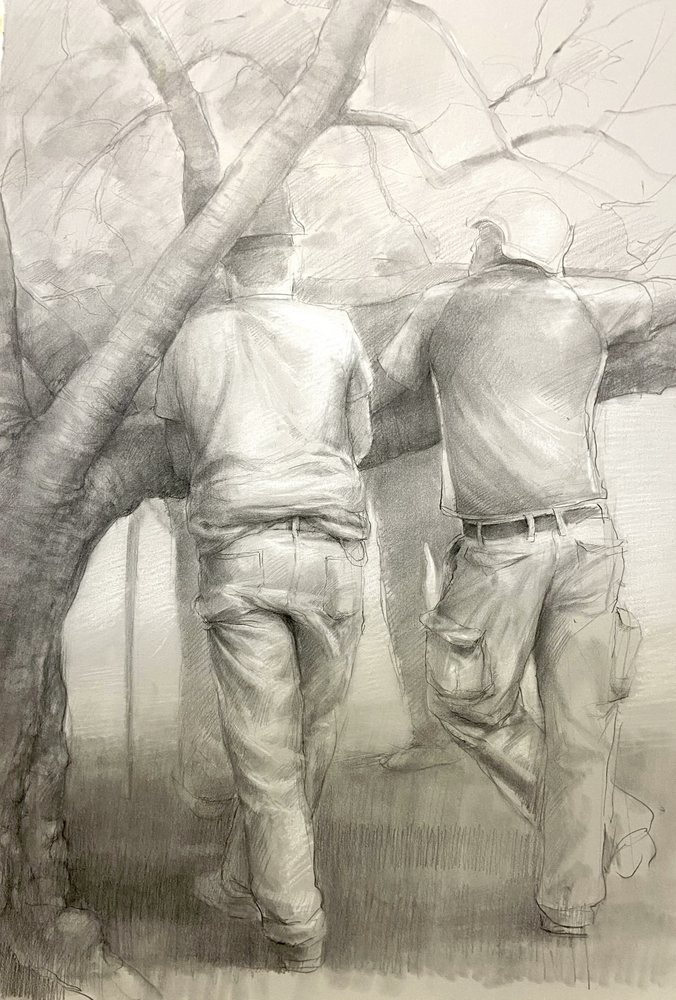
EJ: Were the arborists or landscape workers in Hunt and Meeting on the same property? What was your process for making the painting Fire? It seems more explosive than previous fire paintings. Is it an imagined fire?
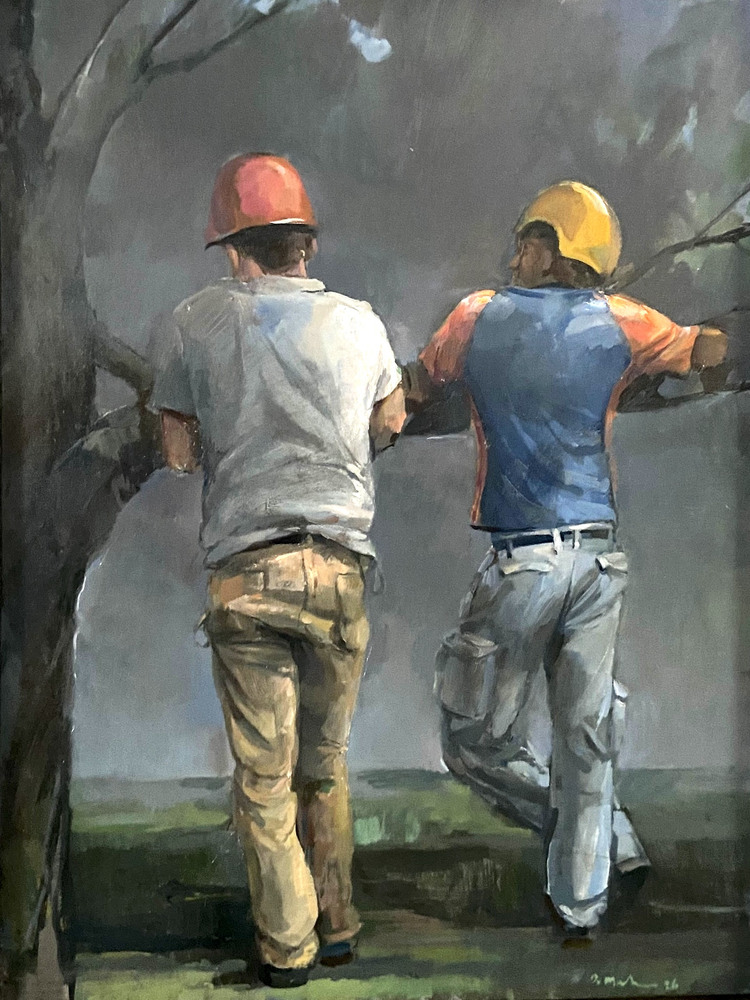
DM: I wanted to paint literal examples of human interaction, the “encounter.” It's always tough to have figures enter paintings: they become a story or narrator. So, I dealt with it by having them turn away or be busy with something. We wonder, “What are they up to?”
Meeting and Hunt are literally this: I saw men in Fairmount Park learning how to prune and maintain the park's trees. Fire developed from an existing landscape painting of a row of trees at the edge of the meadow. I set it ablaze. Some paintings are picked up periodically and worked on until I need them for a show.
I love the free-flowing abstract and menacing quality of these fire paintings.
Two Groups, Oil on wood, 24" x 18"
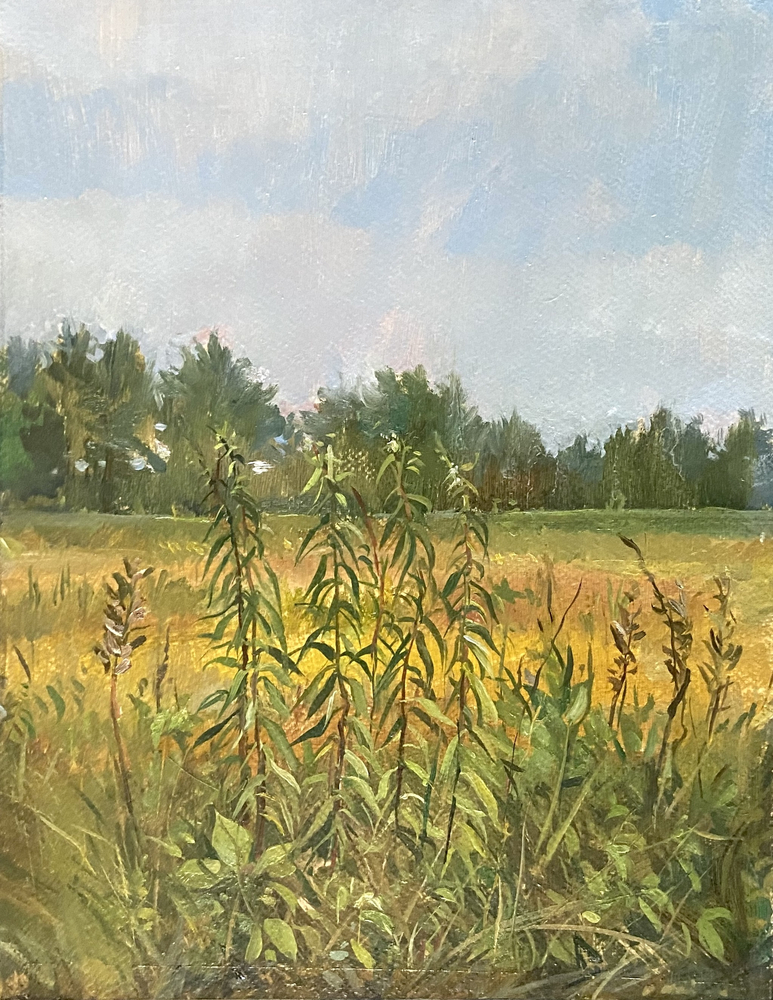
Field Study, Oil on wood, 14" x 11"
EJ: There's Looney Tunes humor in watching a guy look for deadwood to cut in Hunt, as if he were Elmer Fudd after Bugs Bunny. I may be reading too much into this, but Meeting's two guys gabbing as they lean on a tree could be winking at blue collar workers taking a break. How do you relate to these figures interacting with the landscape?
DM: Humor is all around us, perhaps just like there are images/paintings to be made all around us. What a pursuit we have!
EJ: My favorite painting of the group is Field Study because it counteracts depicting space using scale; as for instance, in Field Summer and Two Groups. The flat row of weeds against a background meshes realism and idealism. Did preparatory drawings or watercolors set you up for this success?
DM: That was one of the last paintings I did in Maine this past summer. Maine had another drought. I was working on images of dense weeds, and I looked over the side and saw these very fragile, dry weeds. I loved the way the thin delicate leaves of the row stood in contrast to the large meadow. The juxtaposition of something large in the foreground gives you a great sense of space; in this case it also reveals my lower vantage point.
EJ: Orchard Study also falls among the mysteriously effective to me, which I pin on the relationship between making foliage from dark and light greens and browns, a combination that many painters have used throughout art history. Was this treatment accurate to the subject or more of an interpretation or painterly effect?
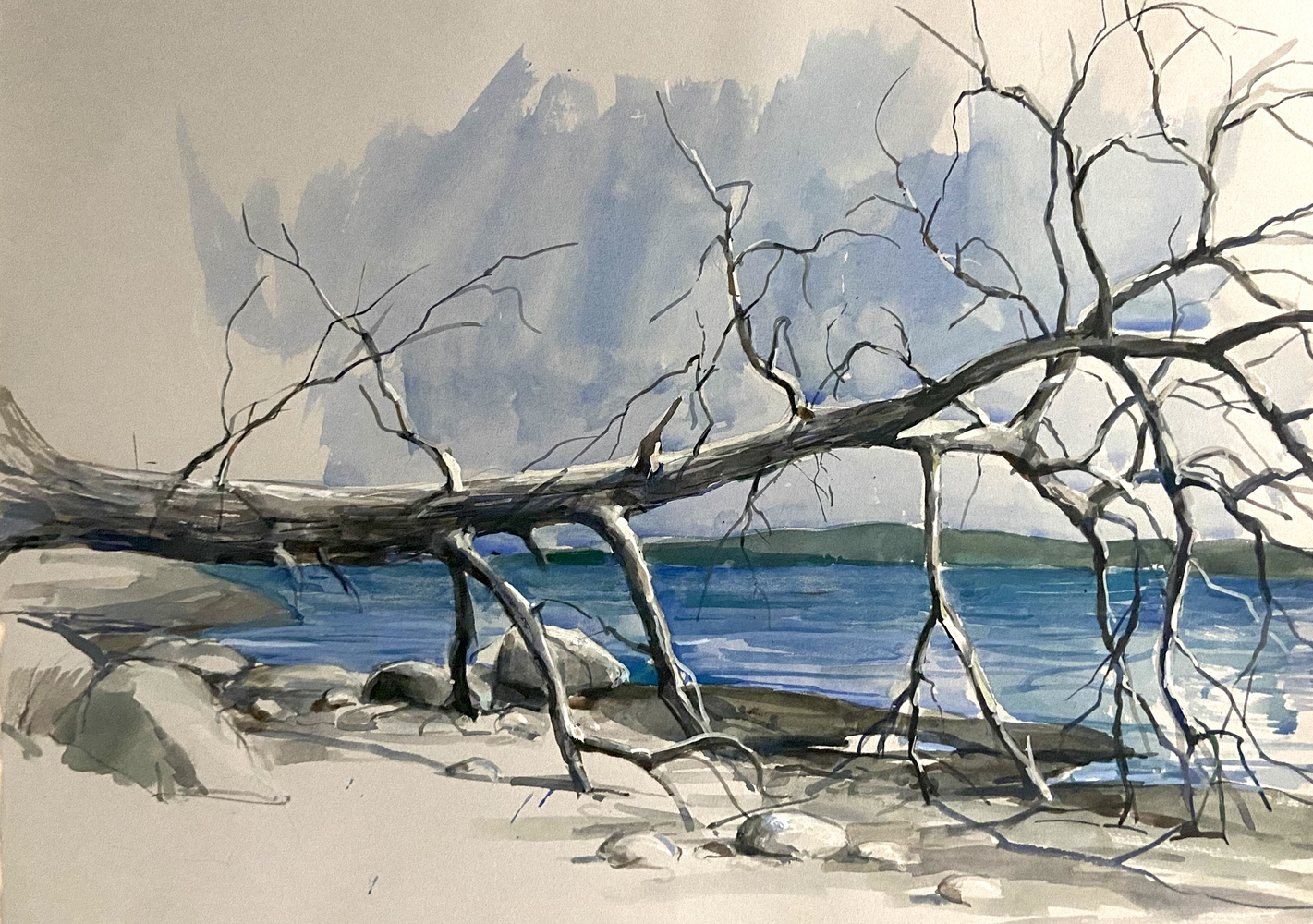
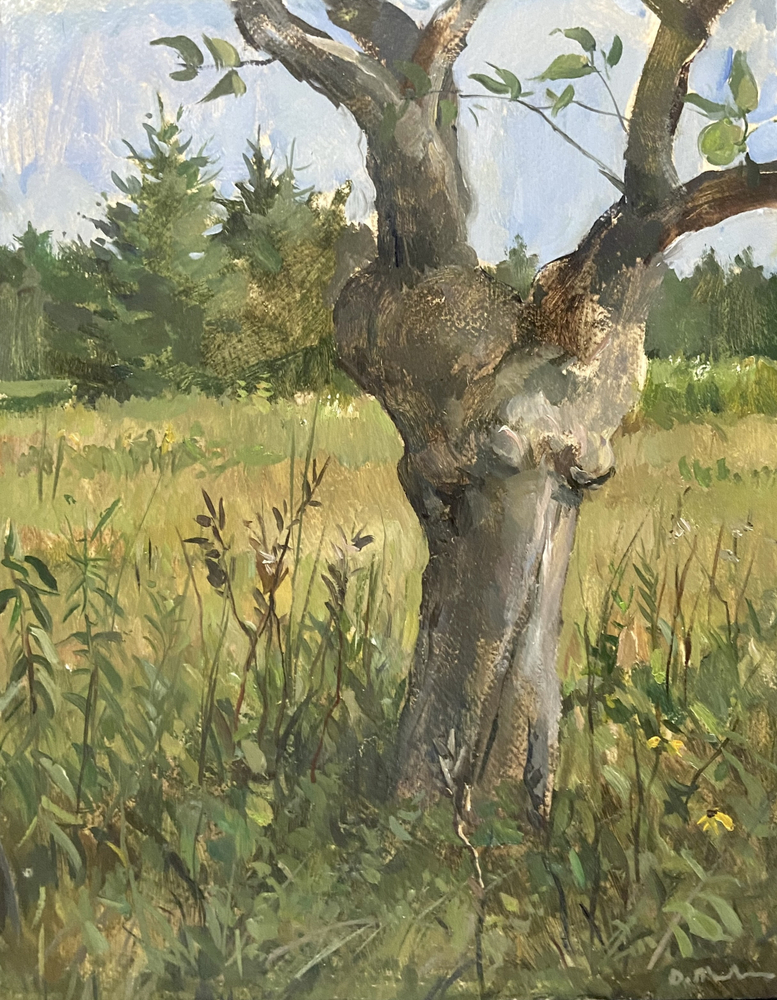
Orchard Study, Oil on wood, 14" x 11"
DM: I was working on a series of drawings when I decided to paint Orchard Study. I wanted to treat it just as I had the drawings. For the drawings, I poured dry graphite powder onto a nice heavy sheet of watercolor paper. I rubbed the graphite in to make this nice even gray tone, draw the object, then erase out the lights. As the drawing progressed, I added more graphite and used opaque watercolor white to bring up the lights. For the painting, I applied a transparent neutral, drew in the trees and weeds, wiped out the lights, then added opaque lights and darks to sculpt to form. This painting is monochromatic because I wanted it to be more like a drawing.
EJ: Making Waves is a pleasant surprise. Is this a view of the ocean beyond the field? Is there a story behind this painting? And what about Push that values work by picturing effort? To you, does the straight line through the heavy load in Push elicit the workman-like firmness of drawing?
DM: In this case we are Sisyphus pushing that boulder up the hill only to have it roll back down. And making waves is, if you will, good trouble. That's been my life lately, maybe all our lives. Art is just holding on, art institutions are just holding on. Things we all thought would always be there are now up for question. We have been told that all art is political, but I don't believe that. When it's just political it becomes too specific and can't speak to other cultures or generations. We all have to be in on the story. Working with images, we don't have a language barrier, the only limitations are self-imposed. Art can be beautiful and have multiple meanings. When I started painting, so much art was sarcastic and negative, which was the way to have meaning and make your work profound. I don’t think that now. I want my work to be beautiful and profound.
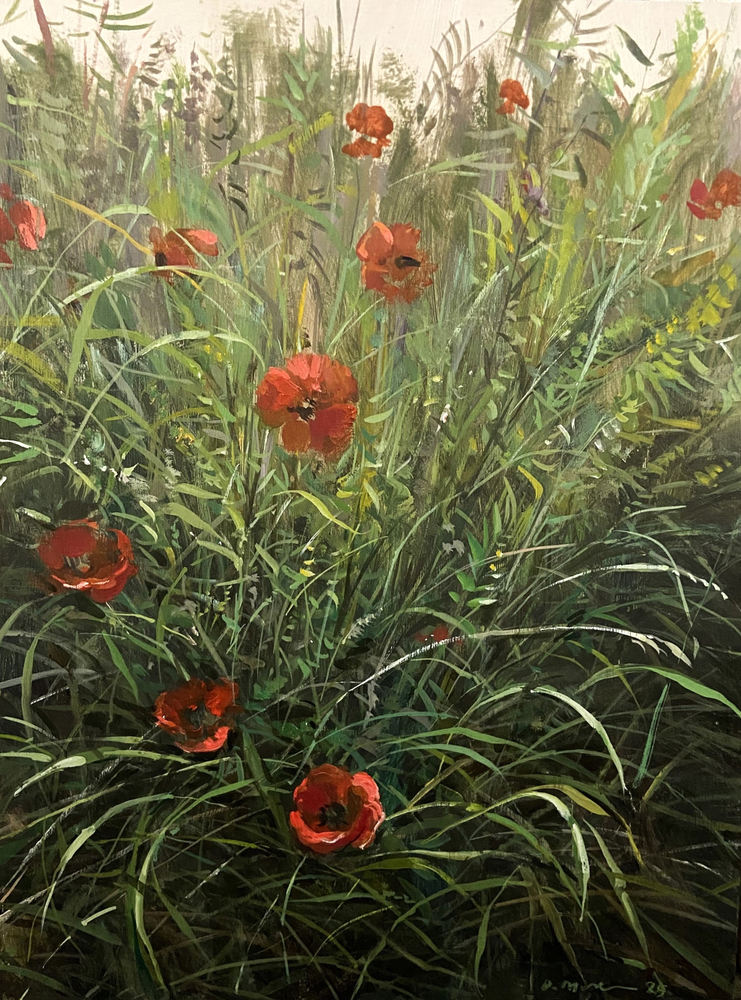
EJ: What was the process of working through the France Poppy paintings?
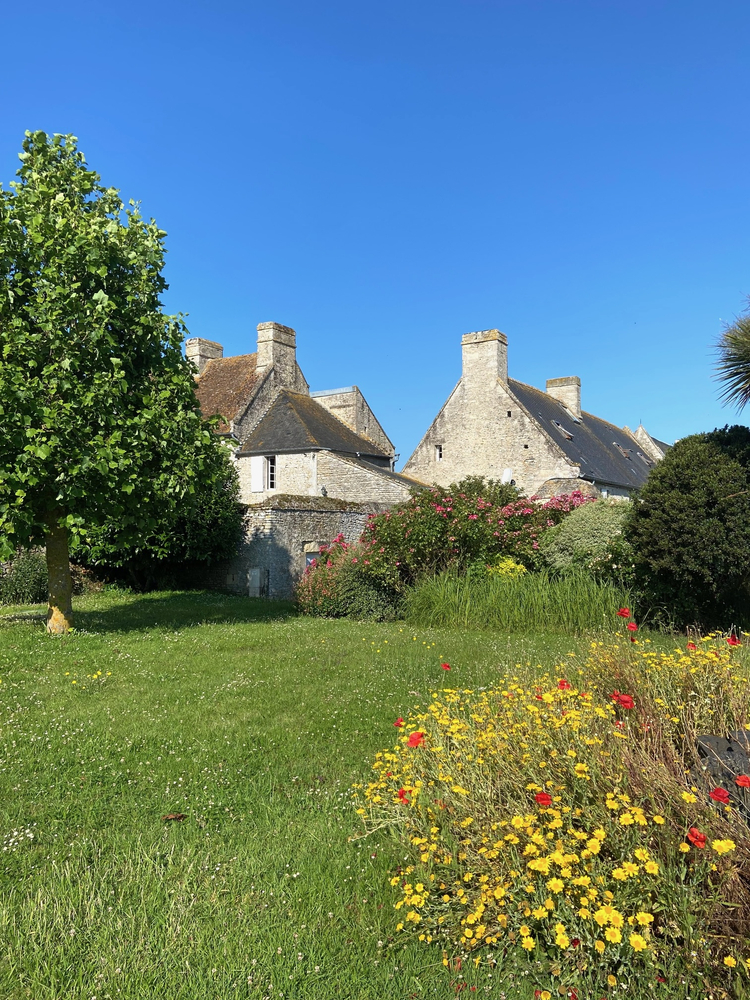
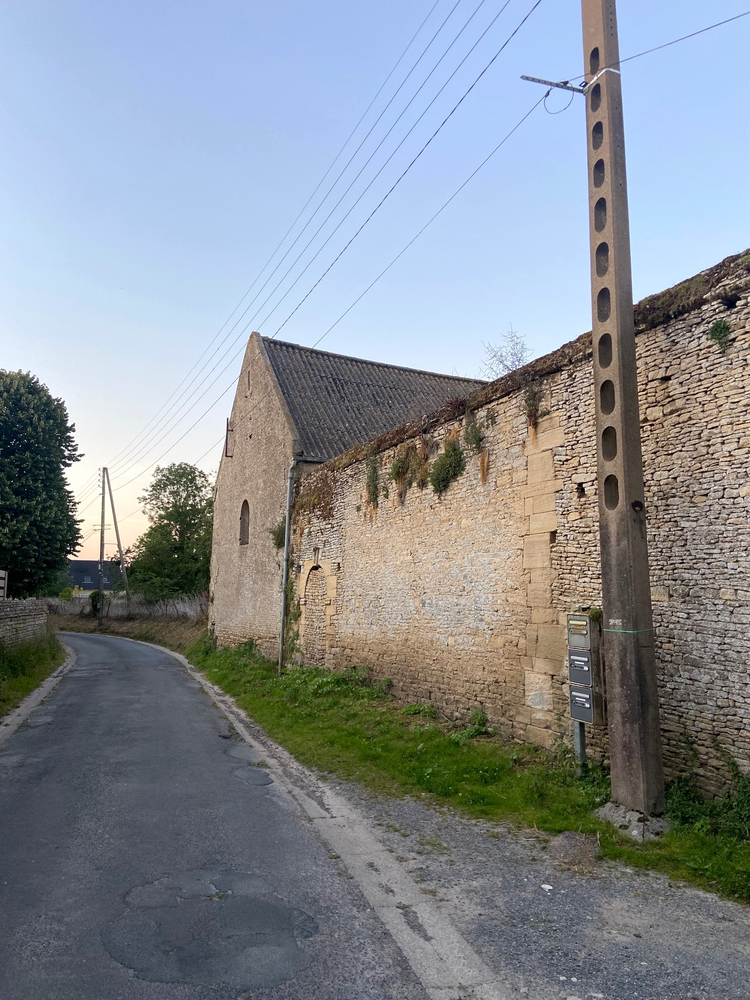
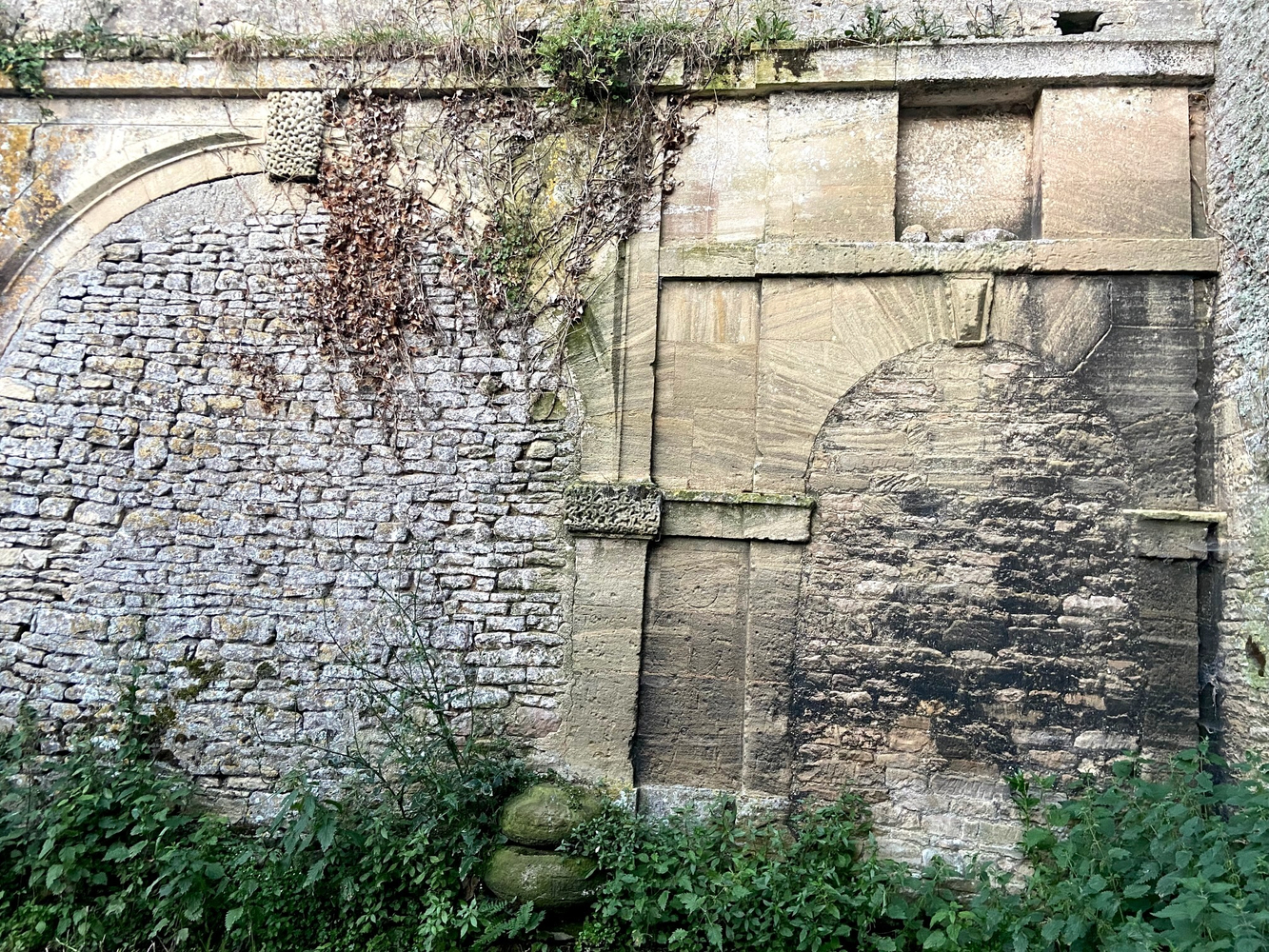
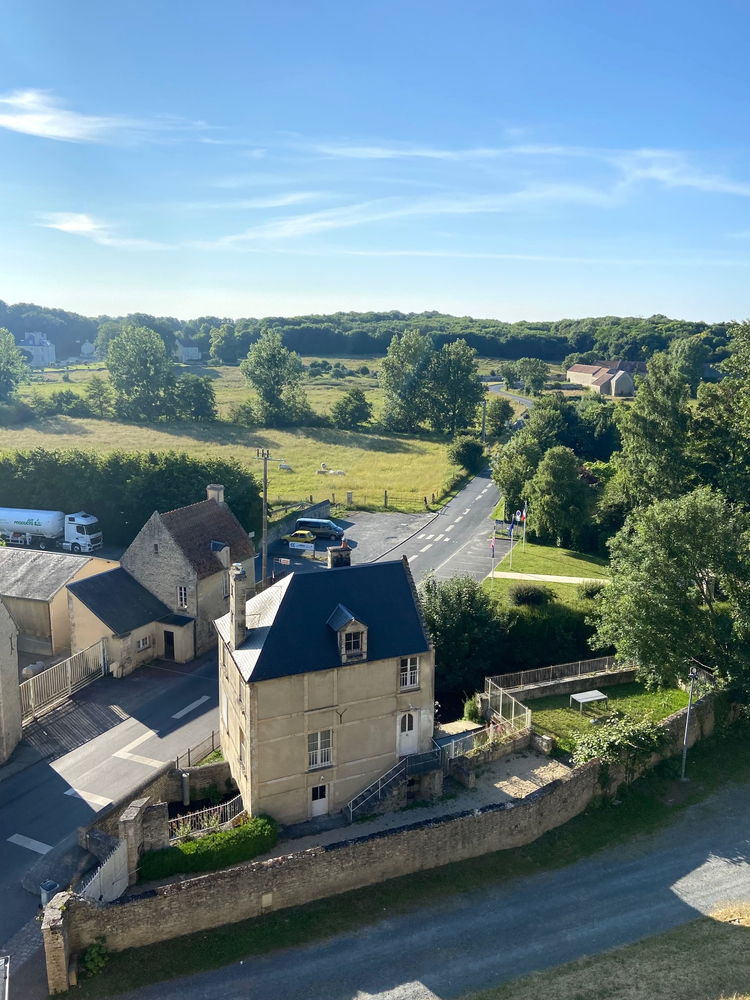
(View the France Poppies paintings &
scenes from Martenson's trip to Normandy, France below:)
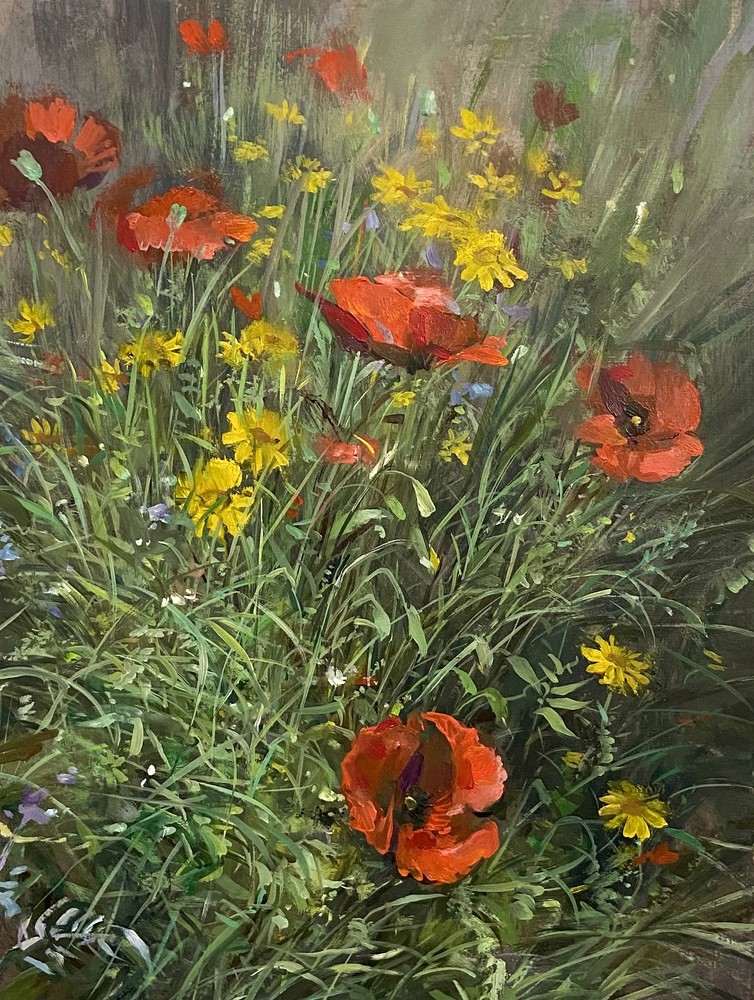
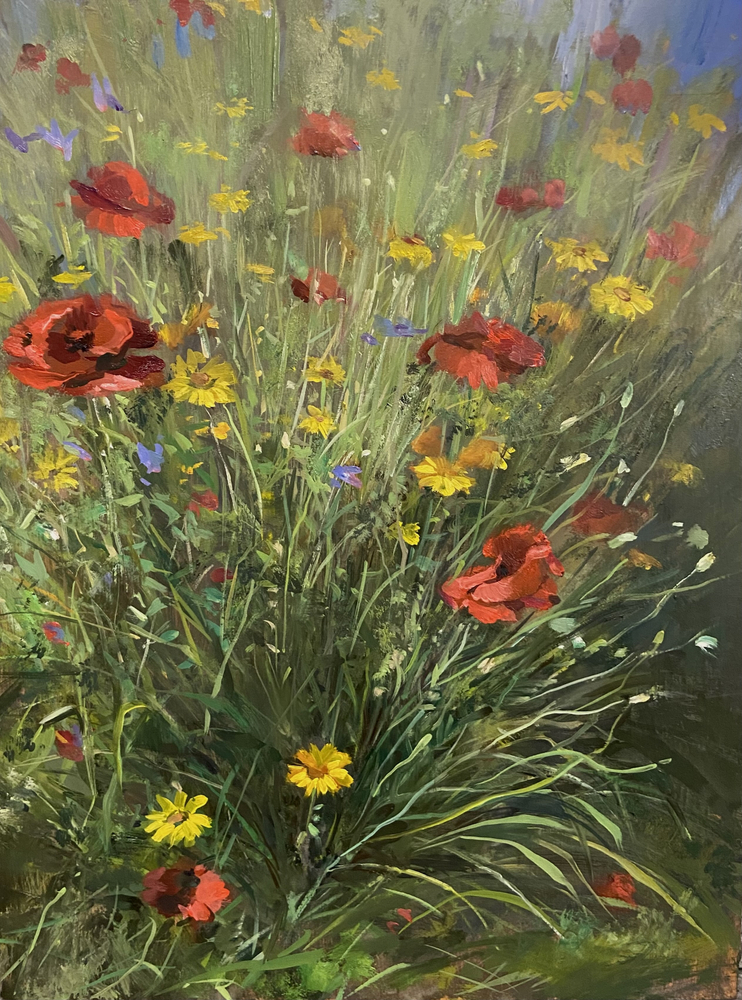
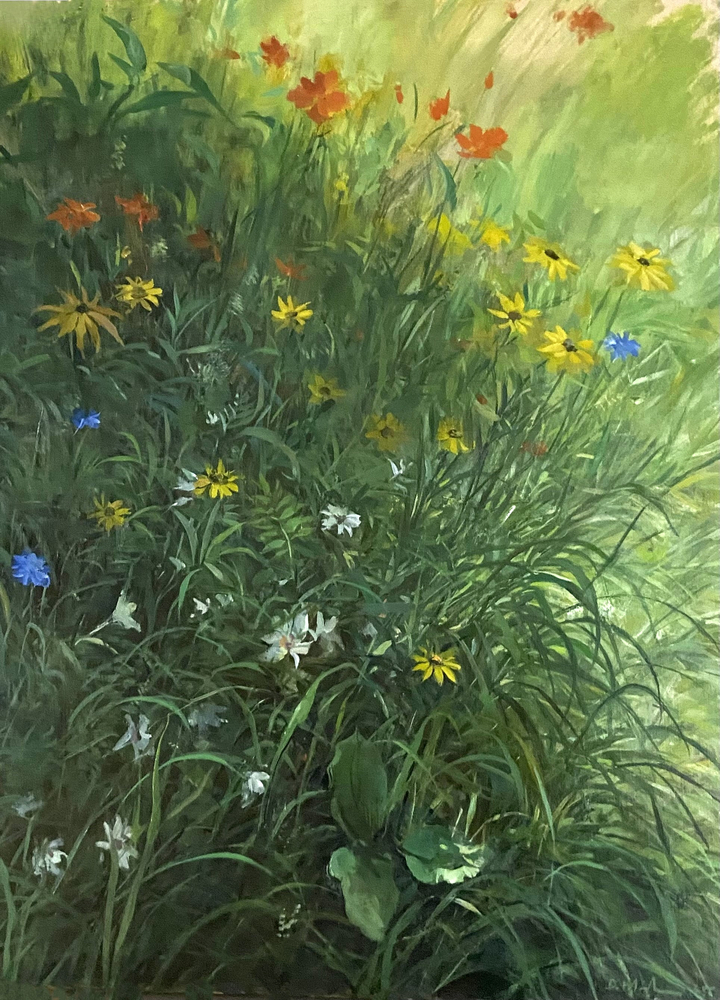
Wildflowers, Oil on wood, 24" x 18"
EJ: France Poppies III exemplifies your quest to engage the whole, since there seems to be less excitement about the flowers and a more somber view of the scene via a grayer background and darker foreground.
Did painting at different times of day give you this breakthrough?
What techniques other than repetition at different times of day helped you go deeper to encounter the meadow?
DM: As for the poppies, they were all around us in the fields when we were in Normandy this past summer.
They were done in different light, different times of day, and in some cases silhouetted against the light. A very fragile weed/cultivated plant gets raised and turned, trampled, cut, but it still perseveres.
This is a metaphor for our existence as artists: we work to achieve ephemeral moments, to achieve beauty, to point out moments and places that in the end have lasting meaning.
––Elizabeth Johnson
(elizabethjohnsonart.com)
edited by Matthew Crain
(@sarcastapics)
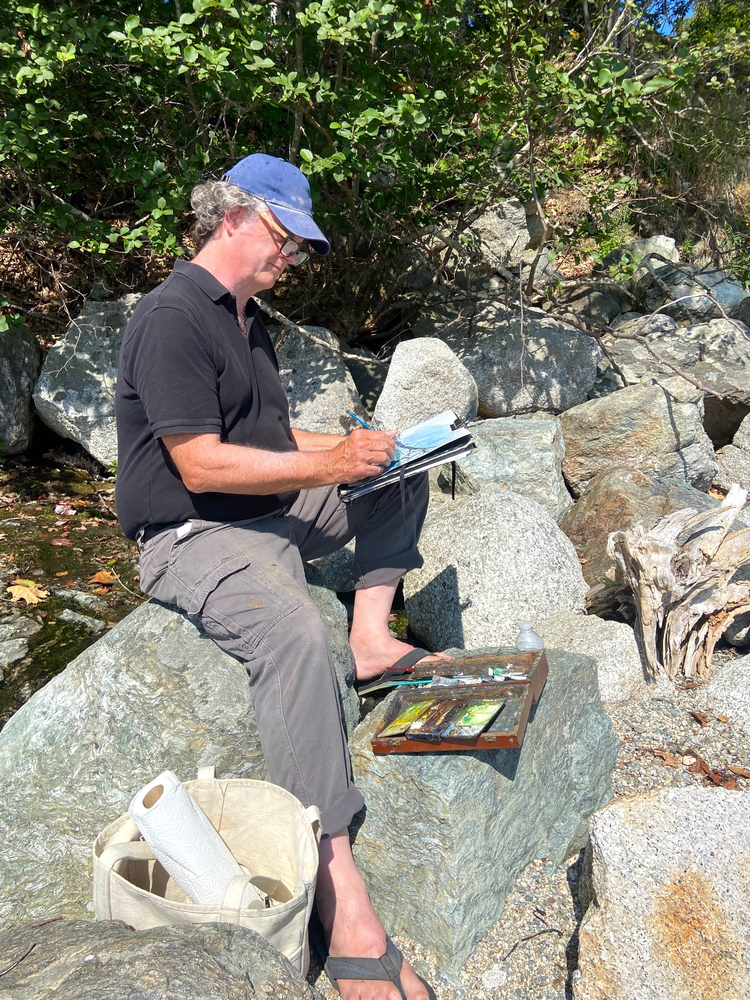
Douglas Martenson painting in Maine
About the Artist
Douglas Martenson has made his home in Philadelphia since 1978 and is a Graduate of the Pennsylvania Academy of the Fine Arts.
His studio is a three story row house located in the Dickenson square area of Philadelphia and the house he rents in Maine is an old farm house located on seventeen acres facing Cadillac Mountain.
Martenson has been the recipient of many grants and awards including a Pennsylvania Council on the Arts Fellowship, several Individual Creative Opportunity stipends from the Pennsylvania Council on the Arts, a Pew fellowship on the Arts grant for study at the Vermont studio center in northern Vermont, and a Cresson European Traveling Scholarship from the Pennsylvania Academy of the Fine Arts.
He has exhibited widely and shows his work regularly in New York, Philadelphia and Boston galleries.
Martenson has recently curated two exhibitions for the Pennsylvania Academy of the Fine Arts; Landscapes Modern to Contemporary (2019) and The Artist’s Response to Nature: Tonalism, Historical to Contemporary (2016).
Martenson was a lecturer at the University of Pennsylvania and is a Professor of Fine Art at the Pennsylvania Academy of the Fine Arts.
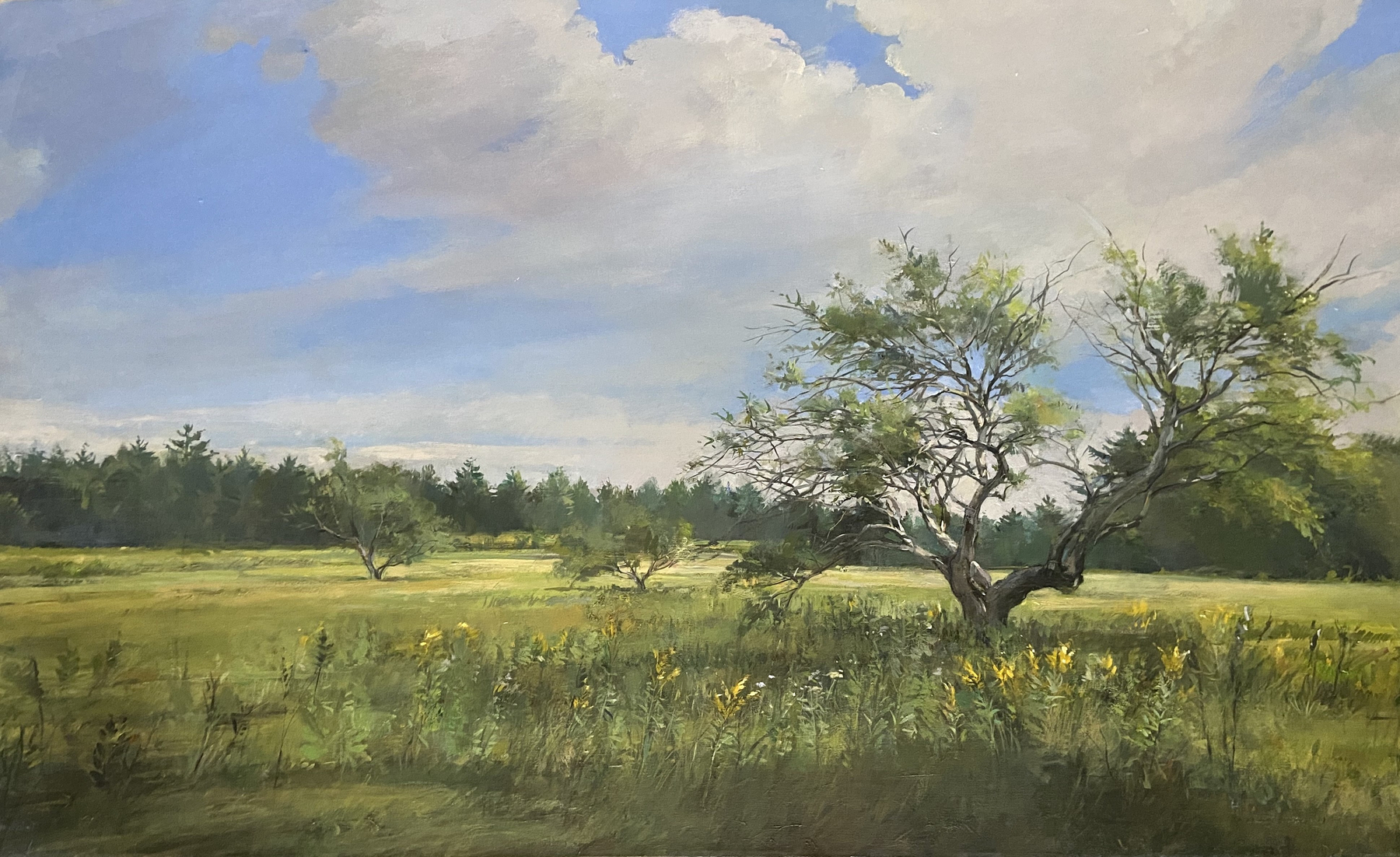
Field Summer, Oil on canvas, 32" x 52"